


Anterior Cruciate Ligament Tear
Andreas Leonidou
Orthopaedic Surgeon
56 Kifisias Ave. & Delfon St.,
Marousi, 15125
- Marousi
- Conservative Treatment
- Surgical Treatment
- Cost
Book Appointment
What Is the Anterior Cruciate Ligament?
The anterior cruciate ligament (ACL) is one of the main ligaments of the knee. It is located in the centre of the knee and extends from the femur to the tibia. The anterior cruciate ligament is largely responsible for knee stability and protects the knee from extreme and harmful movements.
What Is an Anterior Cruciate Ligament Tear?
An ACL tear is one of the most common sports injuries of the knee. Most tears occur as a result of sudden twisting movements, abrupt changes of direction, or an awkward landing on the ground. Sports commonly associated with ACL tears include basketball, football, and tennis.
What Are the Main Symptoms?
Pain
Knee swelling during the first hours after the injury
Stiffness
Knee instability
A sensation that something tore at the moment of injury
A “crack” sound at the time of injury
Diagnosis
Dr Leonidou will take a detailed medical history and examine you. The clinical suspicion is confirmed with an MRI scan of the knee. MRI imaging visualises the cruciate ligament and possible associated injuries to the menisci, cartilage, or ligaments.
What Is the Difference Between a Partial and Complete ACL Tear?
An ACL tear can be either a complete or partial tear. In selected cases of partial ACL tears, conservative treatment may be performed through an individualised rehabilitation programme. However, in general, the ACL must be intact in order to function properly, and therefore even a partial tear may predispose the knee to dysfunction and instability.
What Is the Treatment for Management and Rehabilitation?
In the acute phase, ice therapy, compression and elevation of the limb, unloading with crutches, and pain medication are recommended.
An ACL tear cannot heal on its own, and patients often develop a feeling of chronic knee instability. At the same time, patients may have difficulty returning to their sport.
More importantly, absence of the ACL makes the knee more susceptible to injuries of other structures, such as the menisci, and to the development of osteoarthritis. Therefore, treatment of an ACL tear is surgical, with arthroscopic ACL reconstruction. The only exceptions are knees that have already developed osteoarthritis or older patients who lead a sedentary lifestyle and do not participate in sports activities.
Knee Arthroscopy – Surgical Treatment for ACL Tears
Before surgery, physiotherapy and stationary cycling are recommended in order to strengthen the quadriceps and restore the full range of motion of the knee. Preoperative quadriceps strengthening (prehabilitation) ensures better postoperative outcomes.
Knee arthroscopy is performed without general anaesthesia. Through two incisions on the inner and outer side of the knee (each 4 millimetres in length), Dr Leonidou treats the ACL tear and any associated injuries (such as a meniscus tear).
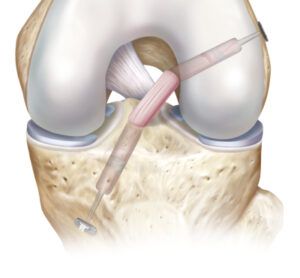
The anterior cruciate ligament is replaced with a hamstring tendon graft. Dr Leonidou harvests this graft through a small incision on the inner side of the knee. The graft is passed through bone tunnels in the tibia and femur. The graft is secured with a small button and a screw until the new ligament integrates into the tunnels.
Recovery After Surgery – When Can I Walk Again?
After knee arthroscopy, patients are able to walk immediately and return home on the same day. In the following days, they follow an individualised physiotherapy programme for rapid recovery and a fast but safe return to sports.
Return to sports usually takes place 6 months after surgery. For professional athletes, there is close collaboration with the coach and the team’s physiotherapist to ensure the athlete’s smooth and safe return to activity.
How Successful Is the Surgery?
Arthroscopic anterior cruciate ligament reconstruction is a safe and bloodless procedure with extremely low complication rates and excellent functional outcomes.
Will I Need Crutches After the Procedure?
After surgery, immediate walking with the use of crutches is encouraged. Patients walk with two crutches, which they can discontinue after consultation with the doctor and physiotherapist once they regain full control of their quadriceps. The period of walking with crutches varies between patients and is usually 3–4 weeks after surgery.
Will I Wear a Knee Brace (Splint) After Surgery?
Dr Leonidou’s experience and expertise in arthroscopic treatment of anterior cruciate ligament tears allow his patients to recover without the use of any knee splint or brace.
Watch the Doctor’s Interview
Watch the Surgery – Arthroscopy Video
What Is the Cost of Surgery? How Much Does the Procedure Cost?
The cost is quite affordable. For more information, please contact us.
If you also suffer from an anterior cruciate ligament tear, consult the specialised Orthopaedic Surgeon Dr Andreas Leonidou. The doctor has 14 years of continuous experience abroad and specialises in knee arthroscopy.
Book your appointment for immediate diagnosis, specialist care, and targeted treatment in just one visit.