


Meniscus Tear
Andreas Leonidou
Orthopaedic Surgeon
56 Kifisias Ave. & Delfon St.,
Marousi, 15125
- Marousi
- Conservative Treatment
- Surgical Treatment
- Cost
Book Appointment
Knee Anatomy – What Is the Meniscus?
The knee joint consists of the distal end of the femur, the proximal end of the tibia, and the patella. Each knee has 2 menisci, the medial meniscus on the inner side of the knee and the lateral meniscus on the outer side of the knee. The menisci are elastic fibrocartilaginous structures composed of water and collagen.
They have a crescent shape and function as supportive structures, absorbing shock during knee movement and distributing body weight evenly across the entire surface of the joint. The menisci contribute significantly to knee stability and lubrication.
What Is a Meniscus Tear?
A meniscus tear is one of the most common knee injuries. The meniscus can tear at any age when it is subjected to significant stress. In younger individuals, tears occur during sudden twisting movements, usually during sports activities. In athletes, meniscus tears are often accompanied by other injuries, such as an anterior cruciate ligament tear.
With increasing age, the menisci undergo degeneration, and the likelihood of developing a tear increases.
Classification of Meniscus Tears
Classification is based on:
Location of the tear: anterior horn, posterior horn, meniscus body.
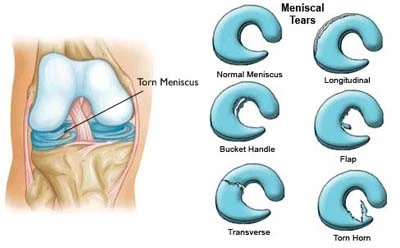
Morphology of the tear: radial, horizontal, longitudinal, bucket-handle, root tear, meniscocapsular tear (ramp lesion), complex.
Repairability/suitability for suturing: Tears located towards the peripheral part of the meniscus have better blood supply and therefore can be repaired, unlike central tears.
Symptoms of a Meniscus Tear – How Do I Know?
A meniscus tear is one of the most common causes of knee pain. The most common symptoms include:
Pain on the inner or outer side of the knee
Knee swelling
Stiffness and difficulty with movement
Pain during deep squatting
Inability to fully extend or bend the knee
Locking and inability to move the knee – indicative of a bucket-handle tear and subsequent trapping of the meniscus between the knee bones
Sometimes a “clicking” sound may be heard
How Is the Diagnosis Made?
Dr Leonidou will take a detailed medical history and examine you. The clinical suspicion is confirmed with an MRI scan of the knee. MRI imaging shows the location and extent of the tear, as well as possible associated injuries to the cartilage or ligaments (such as an ACL tear).
Treatment and Management of a Meniscus Tear
In the acute phase, ice therapy, compression and elevation of the limb, unloading with crutches, and pain medication are recommended. The final treatment of a meniscus tear depends on the type, location, and extent of the tear, as well as the presence or absence of associated injuries to other structures of the knee.
Small – incomplete tears can be treated conservatively with anti-inflammatory medication and physiotherapy to strengthen the muscles around the knee.
Rehabilitation Exercises for Meniscus Tear – Recovery Time
Under the supervision of a physiotherapist and guidance of the doctor, the most common exercises for rehabilitation after a meniscus tear include: knee isometric exercises, flexion and extension exercises, stretching, and quadriceps strengthening.
When Is Surgery Required for a Meniscus Tear?
In larger tears, in athletes, in patients with a locked knee (block), or with associated injuries such as an anterior cruciate ligament tear, surgical treatment with knee arthroscopy is recommended. Arthroscopy is also indicated for smaller tears when conservative treatment has failed.
Particular importance is given to bucket-handle tears, which should be repaired promptly in order to achieve complete healing and restoration of the knee.
Arthroscopy for Meniscus Tear
Knee arthroscopy for a meniscus tear is performed without general anaesthesia and without hospitalisation. Through 2 small incisions on the inner and outer side of the knee (each 4 millimetres in length), Dr Leonidou will treat the meniscus tear using one of the following techniques:
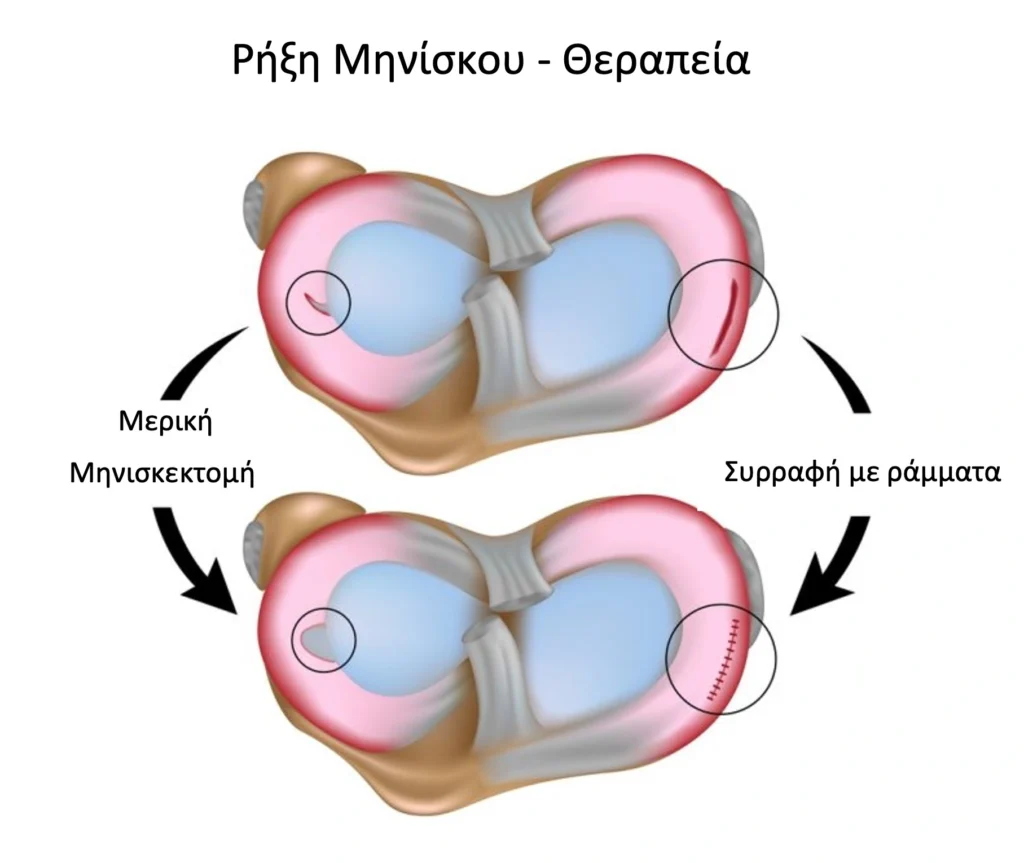
Meniscus repair: Depending on the location of the tear, the meniscus is repaired and the anatomy of the knee is restored.
Partial meniscectomy: The torn part of the meniscus is removed and the remaining meniscus is smoothed. The procedure lasts 15–20 minutes.
Potential Risks of Neglecting a Meniscus Tear
When surgical treatment is indicated, it is advisable to schedule the procedure. The longer you delay definitive treatment, the more the pain may worsen and an even larger tear of the meniscus may occur.
The knee may begin to lock, and your daily activities may be negatively affected. It is now known that a meniscus tear can contribute to the development of osteoarthritis in the future.
Recovery and Rehabilitation After a Meniscus Tear – Is Physiotherapy Required?
After knee arthroscopy, patients walk immediately and return home on the same day, without the need for hospitalisation and without requiring crutches. In the following days, they follow an individualised physiotherapy programme for rapid recovery and a fast but safe return to sports.

The time for full recovery after a partial meniscectomy is 2–4 weeks, and the patient can drive from the first week.
In cases of meniscus repair, restriction of knee movement and weight-bearing may be required, with the use of a functional brace and crutches for a few weeks.
What Is the Cost and Price of the Procedure?
The cost is quite affordable and depends on the size and location of the tear. The cost of the procedure includes the arthroscopic materials, hospital stay expenses, and the fee of the surgical team.
There is also participation from the patient’s insurance fund (EOPYY). Patients with private insurance are covered according to the terms of their insurance policy. For more information, please contact us.
If you also suffer from a meniscus tear, consult the specialised Orthopaedic Surgeon Dr Andreas Leonidou. The doctor has 14 years of continuous experience abroad and specialises in knee arthroscopy.
Book your appointment for immediate diagnosis, specialist care, and targeted treatment in just one visit.