


Calcific Tendinitis
Andreas Leonidou
Orthopaedic Surgeon
56 Kifisias Ave. & Delfon St.,
Marousi, 15125
- Symptoms
- Conservative Treatment
- Surgical Treatment
- Cost
Book Appointment
What Is Calcific Tendinitis?
Calcific tendinitis is a particularly painful condition characterised by the deposition of calcium salts in the tendons of the shoulder (rotator cuff). The rotator cuff is a group of four tendons that contribute to the smooth movement and function of the shoulder.
Why Does Calcific Tendinitis Occur?
The exact cause of the condition is not known. Calcific tendinitis occurs more frequently in women aged 30–60 years, as well as in individuals suffering from diabetes mellitus or hypothyroidism. In 25% of patients, calcifications may occur in both shoulders. In a large percentage of cases, the calcifications will gradually regress (be absorbed) over time.
What Are the Symptoms?
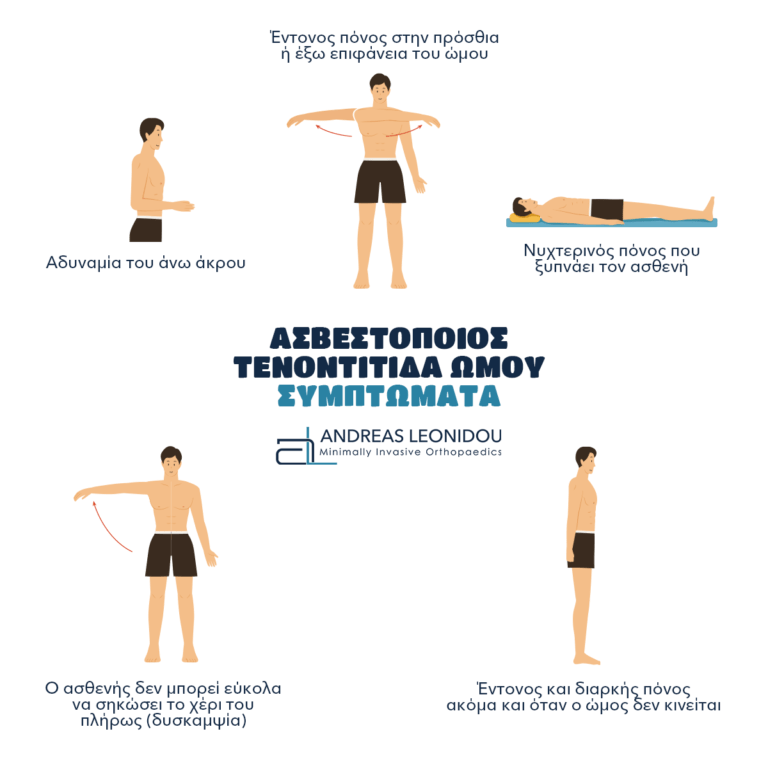
The most common symptoms in the acute phase are:
Severe pain on the front or outer aspect of the shoulder. The pain may radiate as far as the elbow, as well as to the neck and back.
Night pain that wakes the patient, especially if they sleep on the affected shoulder.
Severe and persistent pain even when the shoulder is not moving.
Weakness of the upper limb
The patient cannot easily raise the arm fully (stiffness).
Diagnosis
A patient with calcific tendinitis requires assessment by a specialist Orthopaedic Surgeon. Dr Leonidou will take a detailed medical history and examine you. The doctor will perform an ultrasound scan of the shoulder to assess the integrity of the tendon, the presence of fluid, as well as the size and location of the calcification. An X-ray will be required to confirm that the pain and stiffness are due to calcification and not another cause, such as shoulder osteoarthritis. In some cases, further investigation with an MRI scan may also be required.
Conservative Treatment for Calcific Tendinitis
The initial treatment is conservative and includes the following:
Rest and activity modification
Use of non-steroidal anti-inflammatory drugs
Physiotherapy and a home exercise programme. The exercises aim to reduce pain and restore range of motion. During physiotherapy, shockwave therapy may also be used in an attempt to “break down” the calcifications.
Cortisone injection alone or in combination with other biological therapies
Indications for Surgical Treatment of Calcific Tendinitis
Failure of conservative treatment
Recurrent acute episodes of pain
When the shoulder has become “frozen” and has permanent stiffness
Associated conditions, such as a shoulder tendon tear
Surgical Treatment
If conservative treatment fails, shoulder arthroscopy offers a definitive solution with excellent functional outcomes. Shoulder arthroscopy involves 3 incisions, each 4 millimetres long. Through these incisions, a camera with cold light and the necessary instruments are inserted into the shoulder. Dr Leonidou will clean the inflamed tissues and remove any excess bone that is compressing the tendon (acromioplasty). He will then identify and completely remove the calcification. Exclusively by Dr Leonidou’s team, patients are offered the option of undergoing shoulder arthroscopy without general anaesthesia and without sedation. The specialist anaesthesiologist will administer regional anaesthesia, and the patient will remain awake during the procedure.
Interview with the Doctor about Calcific Tendinitis
How Successful Is Surgery for Calcific Tendinitis?
Arthroscopic treatment of calcific tendinitis is a safe and bloodless procedure with extremely low complication rates and excellent functional outcomes. The patient is discharged from the hospital a few hours after the operation, wearing a sling for 3 days.

The detailed postoperative instructions significantly contribute to a proper recovery.
Download Here
Watch the Surgery
What Is the Cost of Surgery?
The cost is quite affordable and depends on the size of the calcification and the specific materials that need to be used. The cost of the procedure includes the arthroscopic materials, hospital stay expenses, and the surgical team’s fees. The patient’s public insurance fund (EOPYY) also contributes to the cost. Patients with private health insurance are covered according to the terms of their insurance policy. For more information, please contact us.
If you have calcific tendinitis, consult the specialist Orthopaedic Surgeon Dr Andreas Leonidou. The doctor has 14 years of continuous experience abroad and specialises in shoulder conditions.
Book your appointment for immediate diagnosis, specialist care, and targeted treatment in just one visit.