


Wrist Fracture
Andreas Leonidou
Orthopaedic Surgeon
56 Kifisias Ave. & Delfon St.,
Marousi, 15125
- Symptoms
- Conservative Treatment
- Surgical Treatment
- Cost
Book Appointment
Wrist fracture (broken wrist – hand) is the most common fracture overall (17.5%) in the adult population. It occurs more frequently in women, with a 3:1 ratio compared to men, and affects all age groups.
The most common wrist fracture is the Colles’ fracture, in which the distal radius is displaced and tilted backwards. The majority of Colles’ fracture cases occur in women suffering from osteoporosis.
Other wrist fractures include Smith’s fracture (extra-articular with volar displacement) and Barton’s fracture (intra-articular).
TYPES OF WRIST FRACTURE
The types of wrist fractures include the following:
Intra-articular fracture – Extends into the wrist joint.
Extra-articular fracture – Does not extend into the joint.
Open fracture – The broken bone tears through and protrudes from the skin, requiring immediate medical attention as it may lead to a serious infection.
Comminuted fracture – The broken bones have multiple fragments.
WRIST FRACTURE: CAUSES
The most common cause leading to wrist fractures is a fall onto an outstretched hand.
Due to bone fragility, individuals suffering from osteoporosis may sustain a wrist fracture even after a minor fall from a standing position.
In younger individuals with healthy bones, the fracture occurs following a high-impact fall or force applied to the area (car accident, bicycle fall, basketball injury, etc.).
WRIST FRACTURE: SYMPTOMS
The symptoms presented by wrist fractures include:
Immediate and sharp pain
Significant tenderness when touching the wrist area
Bruising and swelling around the wrist
Deformity — the wrist is positioned abnormally
Numbness in the fingers
WRIST FRACTURE: TREATMENT OPTIONS
Treatment options for managing wrist fractures are divided into non-surgical and surgical approaches.
The choice of treatment is based on various factors, including:
Fracture displacement (whether the broken bones have moved out of position)
Multiple fractures (whether fractures are present in several areas)
The degree to which the fracture affects the joint
Injury to the median nerve
The patient’s occupation and activity level
Age
Regardless of the above factors, the immediate management of a fracture involves the application of a splint for comfort and pain control. If the fracture is displaced, reduction must be performed before applying the splint.
WRIST FRACTURE: CONSERVATIVE TREATMENT
If the wrist fracture is in a good position, treatment is non-surgical and includes the use of a splint or cast. The cast usually remains in place for up to six weeks, after which the patient uses a wrist brace that supports the area and can be removed.
Once the cast is removed, a physiotherapy programme is required in order to restore proper function and strengthen the wrist area.
WRIST FRACTURE: SURGICAL TREATMENT
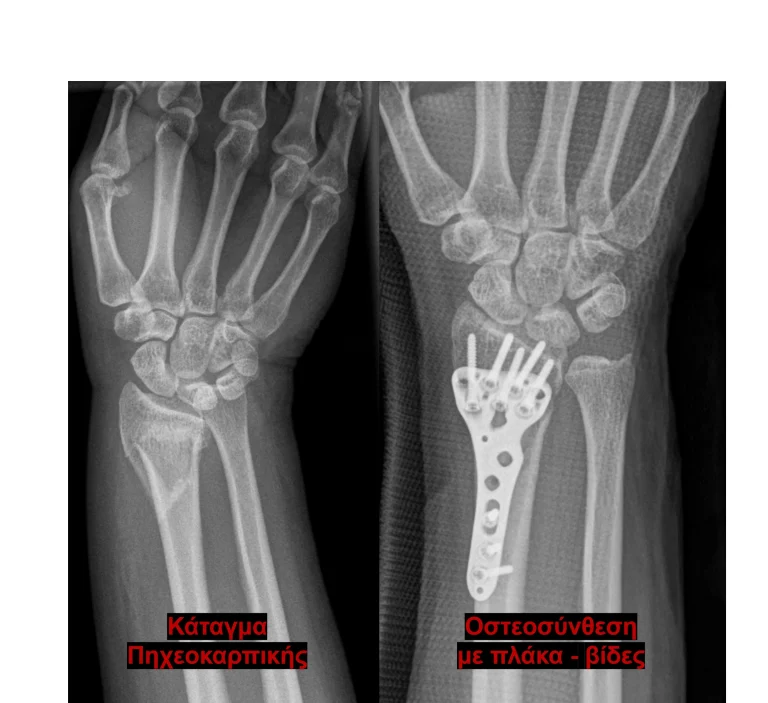
Surgical treatment is usually selected in cases of fractures that are intra-articular, unstable, or cannot be managed with a cast. The procedure is performed without general anaesthesia, and the patient is discharged from the hospital a few hours later. The Orthopaedic Surgeon proceeds with internal fixation and stabilisation of the bones in their correct anatomical position using a specialised plate and screws.
For the following two weeks, the patient wears a splint and then follows a physiotherapy programme for the functional restoration of the wrist.
CAN I HAVE AN MRI WITH INTERNAL FIXATION MATERIALS?
Dr Leonidou uses the most modern and reliable materials. Patients can safely undergo MRI scans postoperatively.
DO I NEED TO REMOVE THE INTERNAL FIXATION MATERIALS?
Removal of the materials is recommended only if they are palpable beneath the skin, cause discomfort, and at least 12 months have passed since surgery.
WHAT IS THE COST OF SURGERY FOR THE TREATMENT OF A WRIST FRACTURE?
It is clear that the cost of surgery for the treatment of wrist fractures is determined by factors such as:
Type of fracture
Severity of the condition
Extent of the injury
Requirements (complexity) of the surgery
Use of specialised materials
Patient’s hospital stay
In general, it is considered an affordable cost for the general public. Part of the cost is covered by the patient’s insurance fund (EOPYY) and/or private insurance, according to the respective terms.
For more information regarding the procedure and the cost of surgery, you can contact us.
If you have sustained a wrist fracture, consult the specialised Orthopaedic Surgeon Dr Andreas Leonidou. The doctor has 14 years of continuous experience abroad and specialises in upper limb surgery.
Book your appointment for immediate diagnosis, specialist care, and targeted treatment in just one visit.