


Humeral Head Fracture
Andreas Leonidou
Andreas Leonidou
56 Kifisias Ave. & Delfon St.,
Marousi, 15125
- Symptoms
- Conservative Treatment
- Surgical Treatment
- Cost
Book Appointment
A humeral head fracture, also known as a shoulder fracture – proximal humerus fracture, is one of the most common fractures in the shoulder area. A shoulder fracture can significantly affect shoulder mobility and the patient’s quality of life, which is why management by a specialised Orthopaedic Surgeon is recommended.
SHOULDER ANATOMY – HUMERAL HEAD
The humeral head is the spherical part of the humerus that articulates with the glenoid. Proper movement of the humeral head allows a wide range of motion. A variety of bony structures and tendons (such as the rotator cuff) surround the humeral head. All of these structures are frequently injured in a shoulder fracture and may lead to pain, reduced mobility, and shoulder weakness.
HUMERAL HEAD FRACTURE – CAUSES
The most common injury mechanism is a fall onto the palm of the hand with the arm either flexed or extended, or a direct fall onto the shoulder. Common causes and predisposing factors include:
Trauma: Falls from height, road traffic accidents, or other high-energy injuries.
Sports activities: Injuries occurring during sports, especially contact sports.
Osteoporosis: Patients with osteoporosis (usually older individuals) have reduced bone density and are therefore more prone to fractures.
HUMERAL HEAD FRACTURE – SYMPTOMS
The main symptoms include:
Pain: Severe pain in the shoulder and upper arm area.
Swelling: Swelling around the injured area.
Limited mobility: Difficulty or inability to move the arm.
Bruising: Bruising and change in skin colour around the fracture site.
Deformity: Change in the shape of the shoulder joint or upper arm.
HUMERAL HEAD FRACTURE – DIAGNOSIS
If you think you have a shoulder fracture, seek medical attention immediately. The Orthopaedic Surgeon will examine the area and request X-rays to confirm the fracture. The X-rays will show exactly where the fracture is located and the extent of the injury.
In some cases, further investigation with a CT scan with 3D reconstruction may be required to determine the extent of the injury. In cases where there is suspicion of injury to the tendons (rotator cuff) or the shoulder ligaments, an MRI scan may be requested.
HUMERAL HEAD FRACTURE – CONSERVATIVE TREATMENT
Most humeral head fractures are treated conservatively. Conservative treatment is indicated for fractures that are non-displaced or minimally displaced. Conservative treatment includes:
Immobilisation: Immobilisation using a sling for 4–6 weeks. The use of a plaster splint is not recommended.
Pain Management: Use of non-steroidal anti-inflammatory drugs for pain control and reduction of inflammation.
Ice Therapy: Ice therapy is recommended for 15–20 minutes, four times a day.
Home Exercise Programme: From the first day of the fracture, an individualised home exercise programme begins to prevent stiffness.
Physiotherapy: Physiotherapy begins 3 weeks after the fracture and includes gradual exercises to restore range of motion and strengthen the shoulder.
Regular Follow-up: Conservative management of a shoulder fracture requires regular follow-up with clinical examination and X-rays.
It is very important that, from the moment a fracture is diagnosed, the patient removes any jewellery from the fingers of the affected hand, such as rings or wedding bands. The bruising from the fracture will move down towards the elbow and fingers, which may become swollen, and if jewellery is present, it may reduce blood circulation.
It is important that the patient is informed from the beginning that swelling and bruising during the following weeks will gradually move down towards the fingers.
HUMERAL HEAD FRACTURE – SURGICAL TREATMENT
Surgical treatment is recommended for more severe fractures, especially those that are displaced and comminuted (multiple fragments). Surgical treatment may include:
Open Reduction and Internal Fixation: The fragments of the broken bone are repositioned and stabilised with a specialised plate and screws.
Shoulder Arthroplasty: In comminuted fractures with multiple fragments where reconstruction of the bone is not possible, the humeral head is replaced with a specialised artificial and fully biocompatible implant (reverse shoulder arthroplasty).
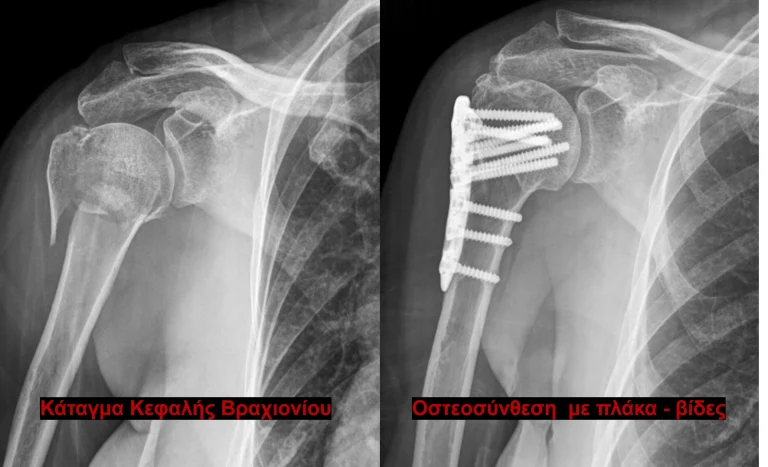
CAN I HAVE AN MRI WITH INTERNAL FIXATION MATERIALS?
Dr Leonidou uses the most modern and reliable materials. Patients can safely undergo MRI scans postoperatively, either with internal fixation materials or with a shoulder arthroplasty.
DO I NEED TO REMOVE THE INTERNAL FIXATION MATERIALS?
Many patients ask whether a second surgery is required to remove the internal fixation materials. Usually, it is not necessary unless the patient experiences pain, stiffness – especially with weather changes – or if the materials are palpable and cause discomfort.
WHAT IS THE COST OF SURGERY FOR THE TREATMENT OF A HUMERAL HEAD FRACTURE?
The cost is quite affordable and depends on the severity of the fracture and the specialised materials that need to be used. For more information regarding the procedure and the cost of surgery, you can contact us.
If you have sustained a shoulder fracture, consult the specialised Orthopaedic Surgeon Dr Andreas Leonidou.
Book your appointment for immediate diagnosis, specialist care, and targeted treatment in just one visit.